Summit Farms normally has the following breeds:
Alaskan Husky

The Alaskan Husky is a highly athletic dog variety, and as it is a crossbreed, its appearance can vary markedly, although various lines have been bred for multiple generations and still breed very true to their l ines' types. Some Alaskan husky lines have characteristic spitz-like features, such as pointed ears and curled tails, while other lines more closely resemble their hound or gundog heritage with tipped or floppy ears, straight tails and tucked up sighthound-like loins.
Alaskan Malamute

The Alaskan Malamute is double coated. The undercoat has an oily and woolly texture and can be as thick as two inches.[7] The outer guard coat is coarse and stands off the body longer at the withers but not more than one inch off the sides of the body. Ears are small in proportion to the head and stand firmly erect when at attention. The Alaskan Malamute is a heavy dog, with a more formidable nature and structure than the Siberian Husky, which is bred for speed. The Alaskan Malamute is bred for power and endurance, which is its original function and what the standard of the breed requires of Alaskan Malamute breeders.
Alaskan Klee Kai

The Alaskan Klee Kai is an American spitz-type breed of dog, developed in the late 20th century as a companion-sized dog resembling the larger Alaskan Malamute and Siberian Husky. It is an energetic, intelligent dog with an appearance that reflects its northern heritage. Bred in three sizes, its weight range is from 5 to 22 pounds as an adult, depending on whether it is a standard, toy, or miniature.
American Eskimo
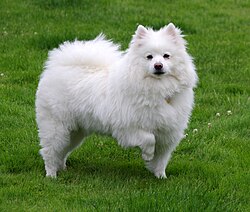
The American Eskimo Dog is a breed of companion dog, originating in Germany. The American Eskimo Dog is a member of the Spitz family. The breed's progenitors were German Spitz, but due to anti-German sentiment during the First World War, it was renamed "American Eskimo Dog." Although modern American Eskimo Dogs have been exported as German Spitz Gross (or Mittel, depending on the dog's height), the breeds have diverged and the standards are significantly different. In addition to serving as a watchdog and companion, the American Eskimo Dog also achieved a high degree of popularity in the United States in the 1930s and 1940s as a circus performer. There are three size varieties of the American Eskimo Dog breed, the toy, the miniature and the standard.
Siberian Husky

The Siberian Husky is a breed of medium-sized working sled dog. The breed belongs to the Spitz genetic family. It is recognizable by its thickly furred double coat, erect triangular ears, and distinctive markings, and is smaller than the similar-looking Alaskan Malamute. The Siberian Husky was originally developed by the Chukchi people of the Chukchi Peninsula in eastern Siberia.[6] They were brought to Nome, Alaska in 1908 to erve as working sled dogs, and were eventually developed and used for sled dog racing.
Samoyed
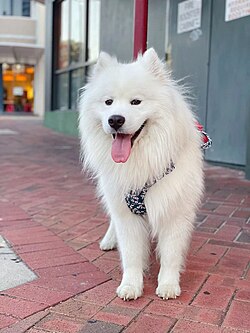
The Samoyed (/ˈsæməjɛd/ SAM-ə-yed or /səˈmɔɪ.ɛd/ sə-MOY-ed;[1] Russian: самое́дская соба́ка, romanized: samoyédskaya sobáka, or самое́д, samoyéd) is a breed of herding dog with a thick, white, double-layered coat. They are spitz-type dogs which take their name from the Samoyedic peoples. Descending from the Nenets Herding Laika, they are domesticated animals that assist in herding, hunting, protection and sled-pulling.A 2.5-year-old male Samoyed Samoyed dogs are most often white, and can have a brown tint to their double-layer coat, which is naturally dirt-repellent. They have been used in expeditions in both Arctic and Antarctic regions, and have a friendly and agreeable disposition
Greenland
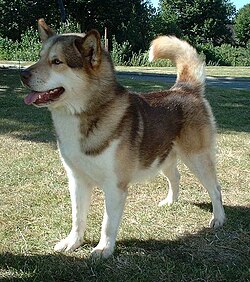
The Greenland Dog is considered nationally and culturally important to Greenland and efforts are made to safeguard its purity. In western Greenland north of the Arctic Circle and the entirety of eastern Greenland, it is illegal to import any dog from outside (except for police and assistance dogs with a special permit), and since 2017 all dogs have to be microchipped and registered in the Greenland dog database. In the southwest, such restrictions are not in place and the purity of dogs is not monitored. As the population has been falling (c. 15,000 in Greenland as of 2016, and 12,000 as of 2021), a number of projects have been initiated in an attempt of ensuring that Greenland's dog sledding culture, knowledge and use, along with the breed itself, are not lost.
Seppala Siberian Sled dog
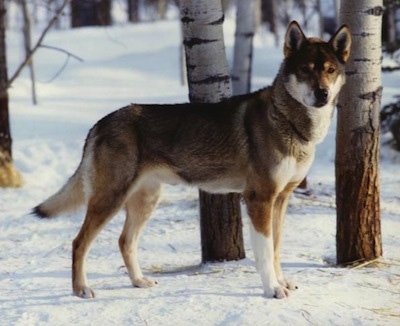
The Seppala is easier to train and they work like no other dog. The work is strong in this group if you are into a sled dog. They are more into the family, and less into fighting everything on four legs they encounter. They are faster and work harder than a normal Siberian. For many years a few dedicated individuals strived hard and gave up much to keep the original line pure. There were some speed bumps, but for the most part they still exist in varying percentage based on pedigrees that date back to the original foundation dogs bred by Seppala. These dogs are in fact the baseline of your very own husky and if you could trace your dog back to the first generation you would find Togo or Fritz as a sire. We all come from somewhere, and Siberians of modern-day come from Seppalas original line.